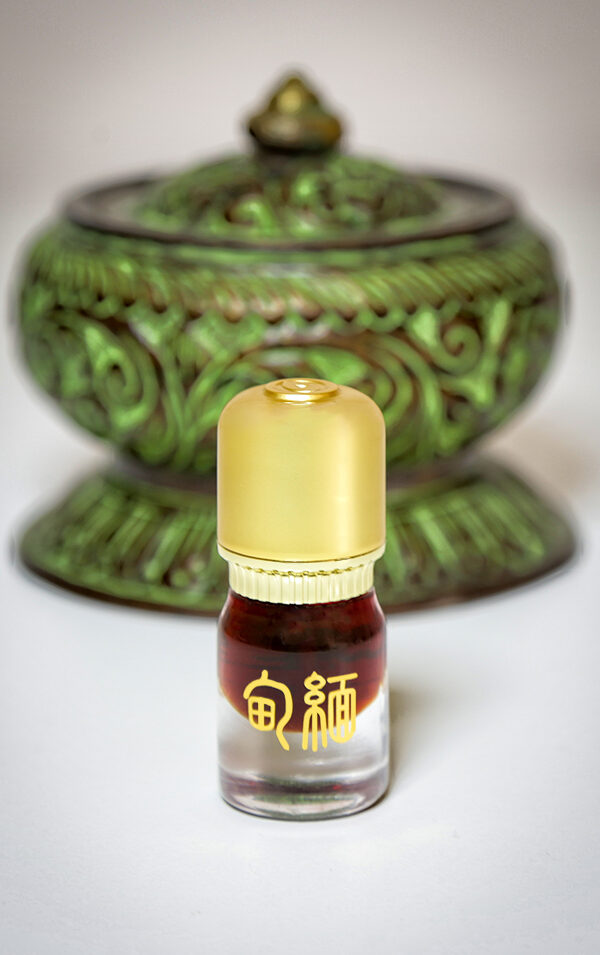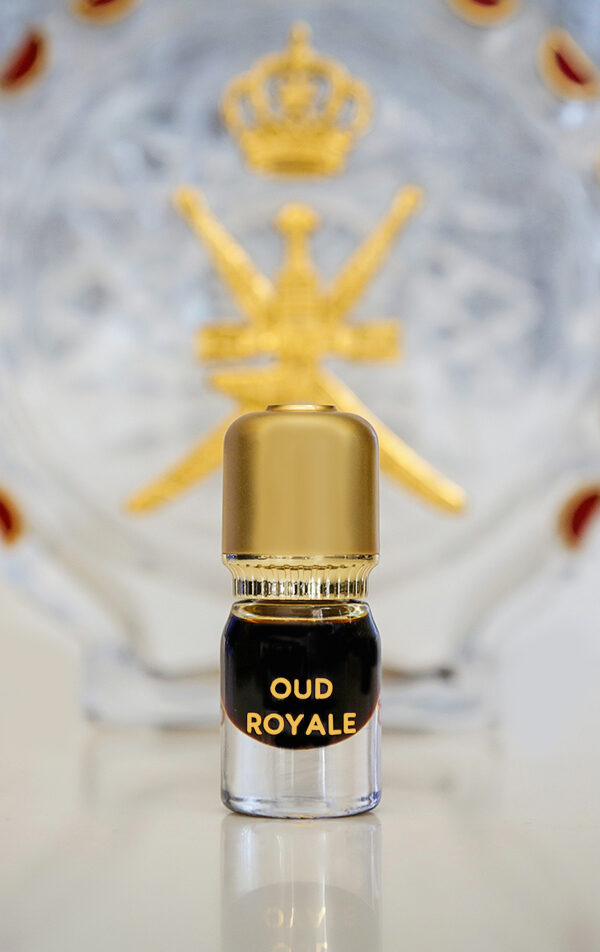
The Kyara Genius
Every genius saves his grand opus for last. The Ninth Symphony was the last thing Beethoven composed, and it is universally recognized as his greatest work. The same can be said of Mozart’s Requiem, Van Gogh’s Arles masterpieces of 1888, Dostoevsky’s Brothers Karamazov. – The same can be said of our Taiwanese distiller’s grand Kyara finale.
With world-cherished masterworks like Kyara LTD, Royal Kinam, Kyara Koutan and Borneo Kinam in his portfolio, you’d think there was little left for him to accomplish in the craft of oud extraction.
But before he abandoned pure oud oil so he could devote his time to carving Vietnamese kyara beads, he distilled one oil which not only matched but completely outstripped all his previous olfactory masterpieces.

I recall him putting some precious Vietnamese kyara carving dust on his low heat electric burner (specially designed for kyara chips) as he handed me the oil. And he gave me some green kyara powder to chew on and keep under my tongue. With a numbed mouth and a nose that was to be numbed even further by his Kyara de Kalbar, I bid him farewell.
A continuous medley of orris, wild fig, blackcurrant, persimmon, and the softest powderiness spontaneously drive the fragrance adrift a wave of resinous Bruneian incense, with a hypnotic pull calling from behind the smoke.
The heart notes rhythmically sway from raspberries to purple grapes to jasmine, while a piercing minty ray shines through every so often as if to whisper ‘Kyara’, before it dances off into a violet drydown.
A lot of things have happened in the China market, the most notable of which is the evolution of their unique kyara school. Departing from the Japanese tenet that kyara can only originate in Vietnam, the Chinese kyara sifus have identified kyara in agarwood harvested in Brunei, Cambodia, Hainan, Laos, and elsewhere. Kyara de Kalbar was literally distilled from Brunei kyara agarwood of a quality that would today command many thousands of dollars a kilogram.
CUSTOMER REVIEWS
If you love the Borneo profile, this is a no-brainer. Like the two Brunei Kynams I sampled last week, this one is golden honeyed fruits and light spices, but this adds what comes across as a slight lemony note as well as a dry woody facet that help the oil feel very balanced. Perhaps the ‘lemon’ facet is simply the result of the high piercing powdery kinamic element mixing with the bright sweetness, as I’ve never heard anyone else describe it that way. That woody note makes this feel slightly more grounded than the ethereal Brunei Kynams, but certainly not in a dark or rich way. It is equally bright and powdery, just adding a more pronounced woody tone in the backbone of the profile.
Of course, the ‘kinam’ element is unmistakable in this, as it was in the Brunei Kynams. There is a prominent bitterness that is piercing and crystal clear that distinguishes this from other categories of ouds. That kinamic element is so perfectly fitting with the bright sweet profile and so unique that it is forever etched into my memory – I can imagine the scent now without having to smell it.
So far in my oud explorations, I’ve found that while I expected to love Borneos based on their profile, they simply don’t quite “do it” for me in the way that Sultan Ahmet’s PNG/Borneo co-distillation did. Of course, this is entirely personal, and I know that many consider these Oriscent Borneos to be among the best ouds ever distilled. Part of me had to resist the (crazy) temptation to pour these into my bottle of mystical lotus to make the most insane attar of all time, as using ouds of this caliber in such a way would be bordering on sacrilege…though I must admit that the thought still does cross my mind occasionally…
—Renzo C. / Canada
Kyara de Kalbar has been climbing its way to being near the top of my collection. This one hangs with the best of them including OG Brunei kynam and OG Borneo Kinam. When picking a wood to pair with this one I needed to grab the best of the best. Kyara from one of the big Japanese houses. This combination is my favorite of all. Oriscent Brunei beast with ancient Vietnamese Kyara. Powdered Blueberries and flowers.
—Abu Naeem / USA